Careful About the Wrong Things
Matching scrutiny to reversibility in mission-driven organizations
Small mission-driven organizations are careful about the wrong decisions. They will burn a week of leadership attention on something a staffer could have closed in an afternoon, and then, in a single meeting, sign off on a commitment that ties up the team for the next six months. Both feel responsible from the inside, and that is exactly the trouble. The feeling of diligence hides what the diligence actually spent, which is the time of the handful of people running the place. When the entire job is to turn too little money and too few people into something that matters, attention paid in the wrong place doesn't just cost a morning. It comes out of the mission.
The variable that sorts these cases is reversibility: how cleanly a decision can be undone, and how much it exposes the organization once it is made. It is not cost, and not visibility in the ordinary sense. Most operating failures I have seen come from applying one standard of scrutiny across decisions that differ enormously along that axis. Here are two opposite examples that make the same point.
A booking that expired
At one organization I worked for, I handled site selection for staff retreats. One year the destination was London, which has no shortage of hotels but a real shortage of hotels with the meeting space, room block, and budget fit we needed. One requirement narrowed the field fast: a conference room with daylight that could seat about 25, plus space nearby for breakouts. I found one that matched. The hold was short, only a few days, but the contract itself was the kind London hotels standardly offer: book early and the group block can be cancelled up to ninety days out for little or no cost, sometimes nothing beyond a small administrative deposit. In other words, signing was itself reversible. The decision sat well inside the authority I already exercised for the rest of the event; in managing award events and other gatherings, I could hire vendors without sign-off. But the hotel went up the chain anyway. The few days lapsed before the decision came back, the hold expired, and we settled for a sub-optimal location.
It would be easy to tell this as a story about leadership getting in the way. But that reading misses the point. The people who slowed the decision were not behaving irrationally; they were applying the organization's default, which was that money-bearing decisions get reviewed. The defect was not in their judgment but in the absence of a rule that separated this decision from the ones that genuinely need leadership review.
The hotel was recoverable, and more recoverable than it looked from outside. It sat inside a budget that was already set and requirements that were already fixed, and the contract could be cancelled up to ninety days out, so even signing it left us a way back for months. Booking a venue that turns out to be a little disappointing for an internal retreat is not the sort of thing that hangs over an organization afterward. The one part that genuinely couldn't wait was the hold, and the review ate the hold. We lost the only thing the decision was actually sensitive to. And because the loss took the shape of an option we no longer had rather than a charge anyone could point at, it never showed up anywhere. Nobody writes "the good room, gone" on a budget line. That is what makes it the expensive kind of mistake.
Now we can turn to something organizations do constantly: publishing under their own name. This decision should get many eyes, and slowly. It is public and permanent, it shapes how the organization is perceived for as long as it stays online, and a poorly positioned piece is not something you quietly unwind.
Putting leadership attention on a public-facing article is good communication practice. But holding up a retreat booking that already met agreed requirements left the staff with a worse venue. Recoverable, yes, but avoidable.
The fix is not fewer approvals. It is a decision-rights scheme that gives recoverable, time-sensitive choices to the person who owns the project and reserves leadership's attention for the decisions that warrant it. An operations function that does this well is not trying to escape oversight. It is keeping leadership's attention from being spent on bookings that will sort themselves out, so there's some left for the decisions that actually bind the place.
A program that should have stayed an idea
The opposite failure is more expensive and much harder to see, because it never produces a moment as clean as an expired hotel hold. Small organizations are fond of generating new programs, and the generating usually happens in a good setting: a retreat or an offsite where there is finally room to think. When there is slack in the budget, the impulse is to use it. Try something. Start an initiative. The impulse is not wrong on its face, but it produces a reliable pathology, which is that organizations do some combination of launching too much, launching too fast, and failing to red-team the idea before it goes live.
The reason is structural, not a failure of anyone's discipline. A brainstorm is built to generate ideas and has almost nothing built into it for setting them back down. Enthusiasm in a room feeds on itself. Once a colleague is attached to a proposal and has a little momentum behind it, being the person who says no costs you something with that colleague, so the room drifts toward yes. And spare capacity in the budget gets read as a reason to launch, which it isn't. Having the room to do a thing tells you nothing about whether the thing is worth doing. Those are two separate questions, and a brainstorm only ever asks the first one.
The bill arrives later, and it arrives quietly. Staff end up spread across more initiatives than the headcount can support, and some of those persist not because they are working but because each has a champion and no one ever built the off-ramp. The pattern holds even when each program is defensible on its own. Every decision looked reasonable in the room; the aggregate is an organization doing too many things at half strength.
And the cost is not only the aggregate. A single program, launched with real enthusiasm and run all the way to completion, can carry the same defect. Here is one version I watched up close. The organization decided to run an open competition: a public call inviting outside contributors to submit proposals on a question central to its mission, with cash prizes and a dedicated site. The idea was good and the enthusiasm was real. What no one planned for was the success case. The call went out, the proposals poured in, and the entire operational load sat on one person, who was quickly overwhelmed. Everyone else had their own work and little bandwidth to spare, but the announcement dates were fixed, so several of us were pulled in to read and rank submissions under time pressure. It worked, in the end. The winners were announced, late. And when it was over, no one could say clearly what the program had achieved beyond the fact of having run it, because no one had decided at the outset what would count as success.
A new program is the inverse of the hotel in every way that counts. It is not bounded; it consumes staff attention indefinitely. It is not easily reversed, because programs acquire constituencies, and killing one is politically harder than never starting it. Its exposure compounds over time instead of expiring in a few days. A decision with those properties has earned scrutiny, and is exactly the kind that should not clear on the strength of a good meeting.
What heads this off is a short, boring list of questions a launch should be able to answer before it goes public. Boring is the whole reason they get skipped. The first one: when does this stop, and on what stated condition? "Let's see how it goes" has never once stopped anything. The second: what happens if it works, and whose plate does the load land on then? And the last one, which nobody enjoys asking, is what would let us say afterward that it had been worth doing at all. A program that can't answer those isn't ready, however good it sounded in the room. The contest answered none of them, and it didn't have to fall apart to make the point. It ran clean to the finish and still left every one of us unable to say what it had been for.
The mechanism that forces those questions is a red-team pass before launch, and its purpose is easy to misstate. It is not there to improve the idea. It is there to give people social permission to say no to a colleague's enthusiasm, which organizations are otherwise bad at. A structured adversarial review turns "I don't want to be the one who shot this down" into "my assigned job here is to find what is wrong." Run honestly on the contest, it would have surfaced the single overwhelmed owner and the absent definition of success before either became a problem. That reframing is most of the value.
One rule, not two
Set the two outcomes next to each other and they look contradictory. One was about moving faster, the other about slowing down. But they both point to the same general rule.
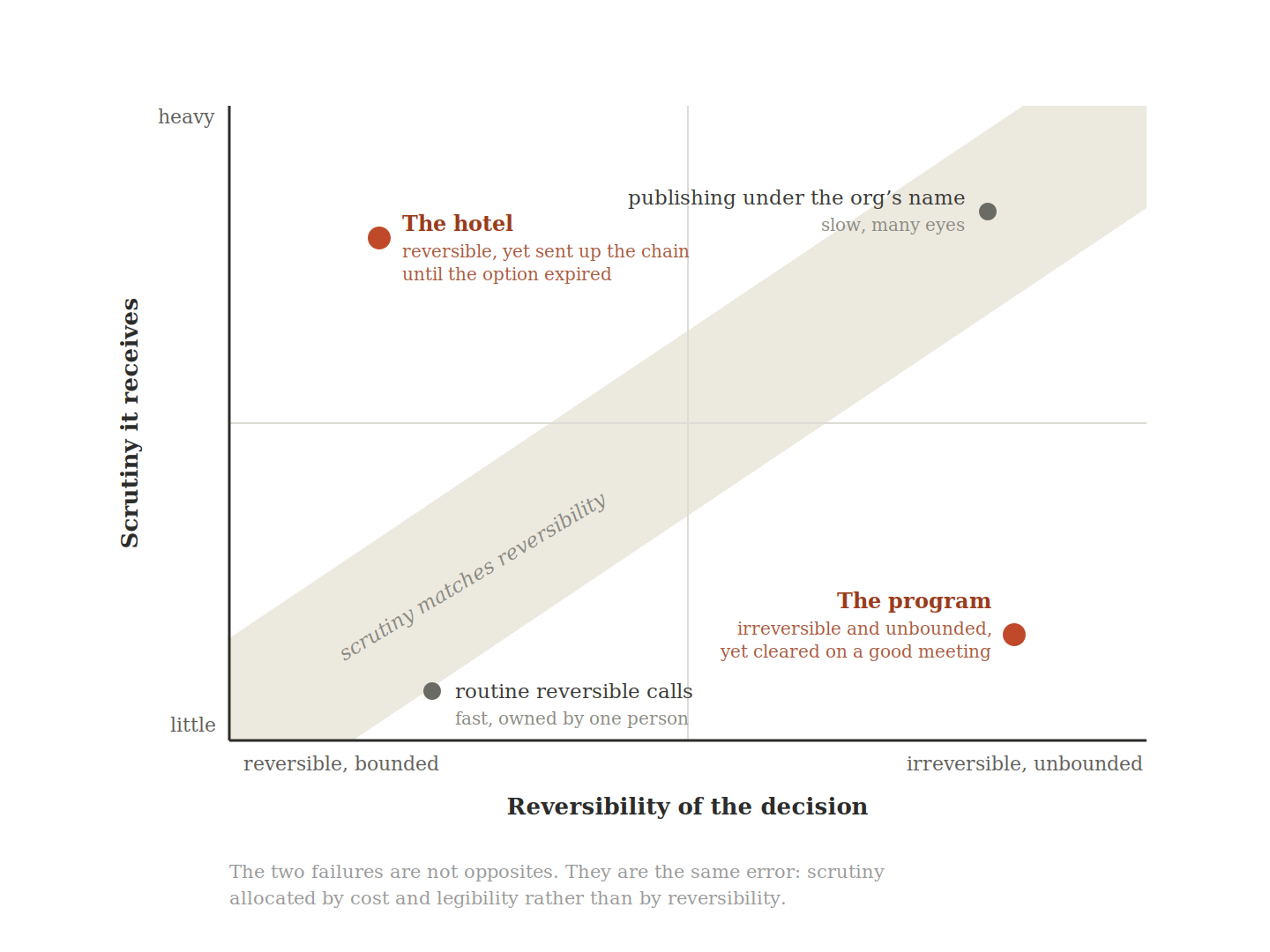
The scrutiny a decision receives should track its reversibility and exposure, not its size or its nearness to money. A hotel booking is reversible and time-sensitive, so it should be fast and sit with the person who owns it. A new program is unbounded, and tends to become irreversible as resources get assigned to it, so it should be slow and should meet resistance before it launches.
What I have watched organizations do, often, is apply the principle inverted. They deliberate the hotel and wave through the program. The scarce scrutiny goes to the decision that has a budget line and a clear owner, because it is legible and reviewing it feels responsible. Almost none goes to the decision that has no budget line yet and will quietly consume the next two years of someone's capacity. The lower-stakes decision gets the attention while the more consequential slips by.
Two objections
Two reasonable objections are worth taking seriously rather than waving off.
The first: reversibility is genuinely hard to call in advance and getting it wrong isn't symmetric. If a staffer reads a situation wrong and acts alone, the damage can run far past the cost of the odd expired hotel hold. On that view the approval queue isn't a reflex, it's insurance against people misclassifying their own decisions, and buying crude insurance is sometimes the smart thing to do. That's right, and it's the reason the fix isn't to shove every decision down to whoever happens to be closest to it. The fix is a small set of categories with thresholds the organization agrees on ahead of time, while it's calm, so that sorting a decision stops being a judgment the staffer has to make alone in the moment and becomes a rule that was already set.
The queue itself doesn't have to go. It just shouldn't treat every decision as equally worth reviewing. When it does, the small, recoverable stuff soaks up the same scrutiny as the rare decision that could have a more lasting impact, and reviewers only have so much attention. Spend it on the hotel booking and there's less of it left when something genuinely irreversible comes through.
The second objection is that raising the bar to launch invites decision paralysis. An organization that red-teams every idea to death stops trying things, and for a young group the cost of missed bets can exceed the cost of overcommitment. This too is correct, and it points at what actually carries the weight, which is making each attempt cheap rather than making the bar high. The goal is smaller initiatives, scoped and time-boxed, with an agreed end and a clear owner. A reversible pilot is how an organization tries more things, not fewer, because it lowers the cost of each bet to where the organization can afford a portfolio of them. The paralysis comes from treating every new idea as a permanent commitment that demands exhaustive vetting. The solution is to distinguish trying from committing, which keeps the stakes low until the time is right to commit.
What operations is for
The job is to build the small amount of structure that sends each decision to the right level of deliberation, so that fast things move and consequential things get caught. This rule allows organizations to be careful about different things. It spends its scarce attention where reversibility says the attention belongs, and for a group trying to turn limited resources into something that matters, that is a large part of whether the resources are well spent.
Note on method. The argument, the research, and the sourcing here are mine. I used a large language model for editorial work: organizing the structure and revising at the sentence level. It did not select sources, generate claims, or decide what the essay argues. Every factual statement was checked against the primary sources cited.