From Sunningdale to Good Friday
Why one power-sharing deal collapsed, why the next one held, and what the years since have done to the argument
This essay started as my 2009 Harvard master's thesis, which asked why the Sunningdale Agreement collapsed and the Good Friday Agreement held. I've cut it down for a general reader and sharpened the claims. I've also added something the thesis couldn't: a look back from 2026, across the years it never saw coming, Those years included Brexit, a devolved government that keeps collapsing, and shifts in who votes and who lives there. The history is the original work. The reframing and the retrospective are new. I'm not claiming settled expertise here. The more interesting question is whether the old argument still holds after seventeen years of events it could not have anticipated.
1. The puzzle
In 1973 the British and Irish governments sat down with the main constitutional parties of Northern Ireland and signed an agreement at Sunningdale. It set up a power-sharing executive, where unionists and nationalists would govern together; an assembly elected by proportional representation; and a Council of Ireland that gave the Republic a real if limited role. Five months later it was gone. What killed it was a loyalist general strike enforced by paramilitaries. The strike was backed by most of the Protestant community. The result was the province shutdown and took the executive with it.
Twenty-five years later the same two governments came back, this time with a wider set of parties, and signed the Good Friday Agreement at Stormont. The architecture was strikingly similar: power-sharing again, an assembly again, recognition of an Irish dimension, and the principle that the constitution couldn't change without majority consent. This time it held. Referendums north and south ratified it, the violence wound down, and the longest deployment in modern British military history finally ended.
The resemblance was close enough that Seamus Mallon, the SDLP's deputy leader, called the Good Friday Agreement "Sunningdale for slow learners." It's a good line. It's also a trap, because it suggests the only thing that changed in twenty-five years was that people finally wised up. But if the two agreements were so alike, why did one die in months and the other live? It can't be that the negotiators got cleverer or the drafting got better. The points barely changed. Something outside the text had shifted between 1974 and 1998, and the text is not where you'll find it.
What changed was not the design of the settlement. It was the structure of power around it.
2. The argument in brief
The 2009 thesis pointed to two things that set the two attempts apart. The years since have sharpened both.
The first I called power entrenchment: the long habit of unionist control over Northern Ireland's political fate, resting on the assumption that Britain would always back them. This was not the ordinary advantage of an incumbent. It was something closer to a structural veto, three centuries in the making, built into the law, the electoral maps, the police, the economy. In 1974 it was fully intact. So when unionists decided Sunningdale was a threat, they had both the means and the unspoken permission to bring it down.
The second was paramilitary inclusion: whether the people most capable of wrecking a settlement were inside the room or shut out of it. At Sunningdale they were shut out. Nobody was talking to the paramilitaries on either side, and the loyalists who enforced the 1974 strike had no reason to protect a deal they had no part in. By 1998 that had changed. Years of back-channel contact, ceasefires, and prisoner deals had drawn the major armed groups into the process as participants. And an actor with a stake in the settlement is an actor with a reason not to break it.
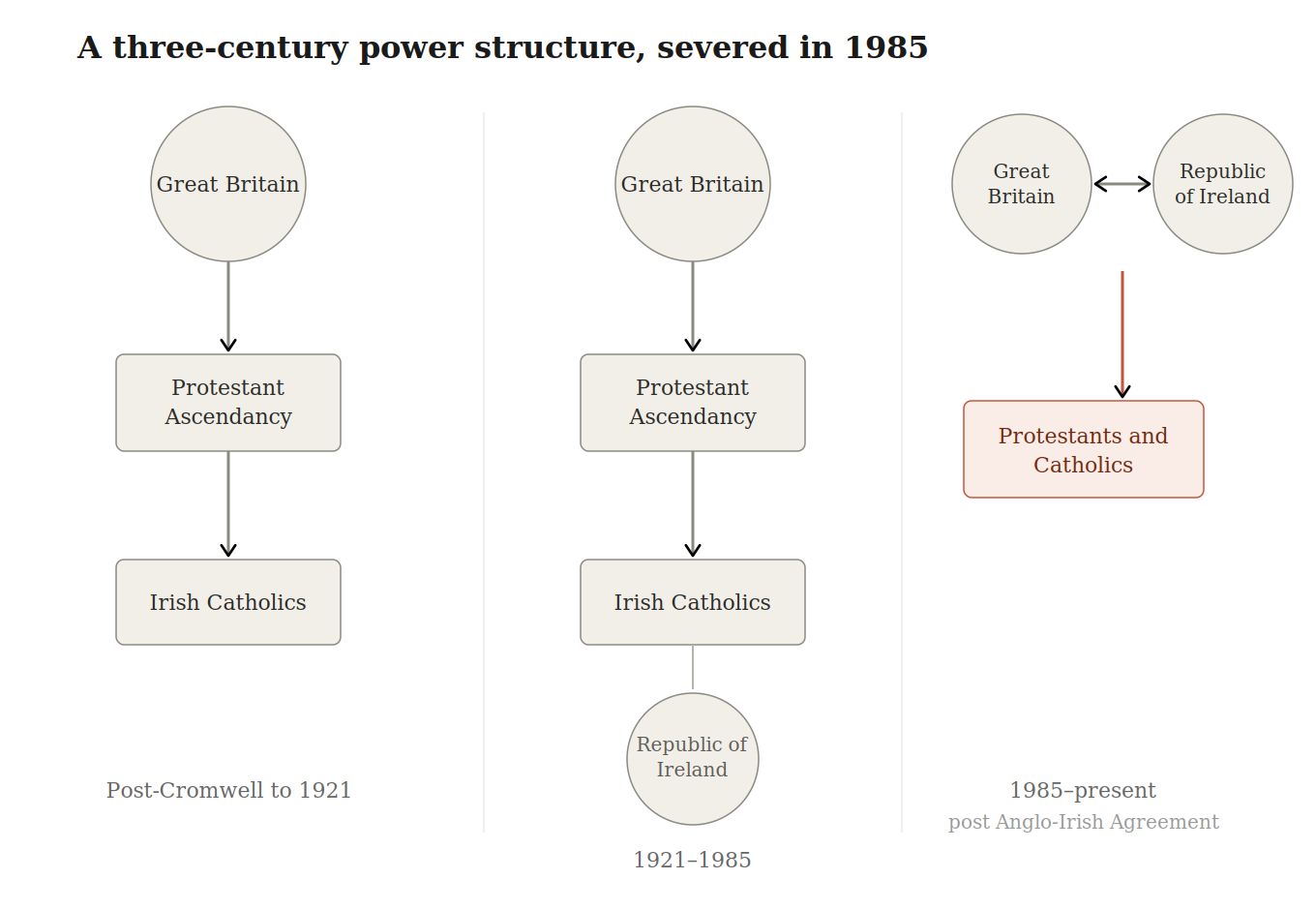
Between the two sits the event that changed the first factor: the Anglo-Irish Agreement of 1985. This is the hinge, and it's worth being exact about what it did and didn't do. My 2009 thesis sometimes said the Agreement "destroyed" unionist power entrenchment. That's too strong. What it destroyed was one mechanism, the single most important one: the unionist ability to count on British backing to veto whatever they disliked. London signed a treaty with Dublin giving the Republic a consultative voice in the North's affairs, and then, facing enormous unionist protest, refused to budge. The message was unmistakable. The old veto no longer worked, and a settlement that could not have survived in 1974 could survive in 1998.
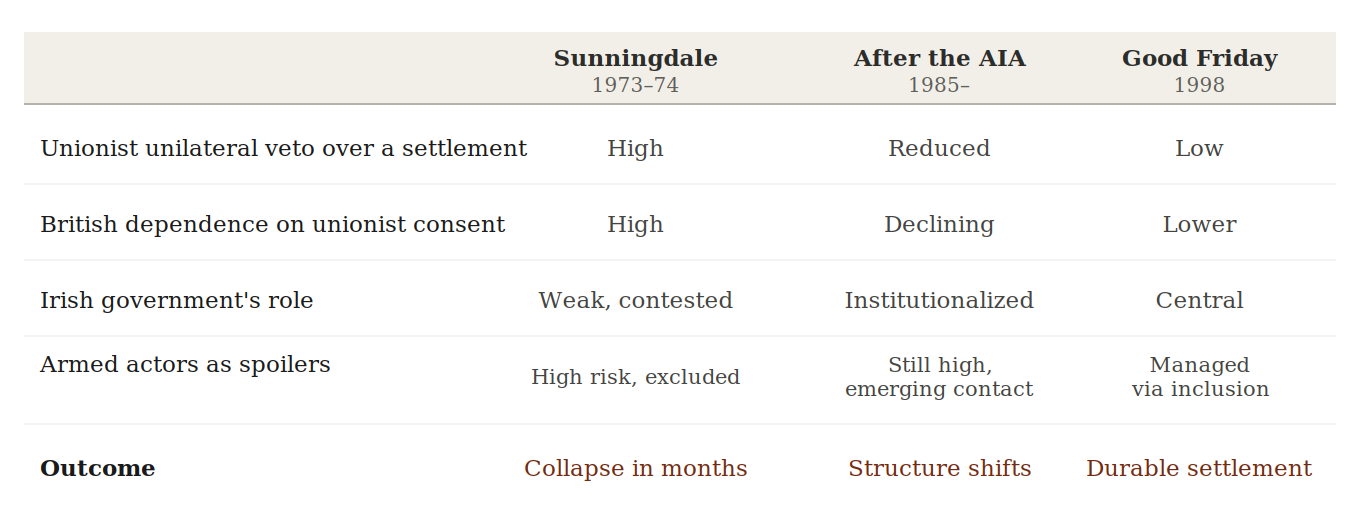
So here's the refined claim. The thing that separated Sunningdale from Good Friday was not the institutional design. Both had power-sharing, both had an Irish dimension. It was sequence. A unilateral unionist veto, weakened by the Anglo-Irish Agreement; British-Irish cooperation, now permanent; armed actors, finally brought inside. Good Friday worked because it turned an armed struggle over who dominates whom into a constitutional argument conducted indoors, under rules.
A word on how the argument works, because it shapes everything after. This is a structured comparison, not a controlled experiment. Sunningdale and Good Friday aren't two identical cases differing in exactly two variables, and I won't pretend they are. Setting them side by side is a heuristic: it's the very closeness of the two agreements that makes their different fates worth explaining, and the explanation is in how specific mechanisms changed over time. Nothing below did the work alone. Weakening the unionist veto was what made a settlement possible; bringing the paramilitaries in was what made it stable; the ceasefire management, the prisoner releases, the police reform, the British-Irish machinery: those were what kept it standing. The point is how they combined, and in what order.
3. Three centuries of entrenchment
To understand why the unionist veto was so formidable in 1974, you have to understand how old it was. The dominance that brought Sunningdale down didn't start with the Troubles. It started in the seventeenth century and built up, layer on layer, for three hundred years.
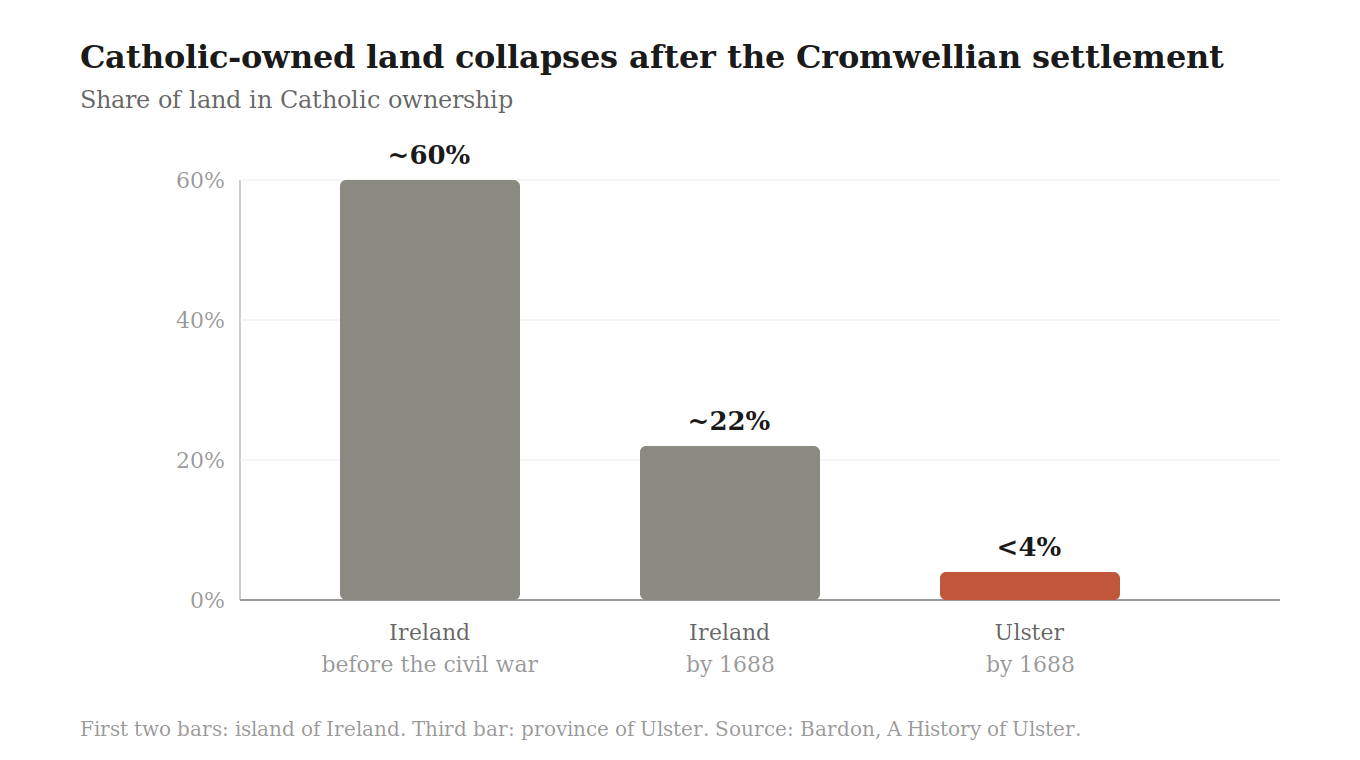
The decisive break was the Cromwellian settlement. After the 1641 rebellion and the wars that came after it, Cromwell's campaign and the 1652 Act for the Settlement of Ireland moved land from Catholic into Protestant hands on an enormous scale. The numbers are the story of a society remade by confiscation. Catholics had held roughly 60 percent of Irish land before the English civil war; by 1688 that was down to about 22 percent, and in Ulster to under 4 percent. Land was where wealth and power came from, so its transfer became the foundation of the Protestant Ascendancy. The Williamite wins at the Boyne and Aughrim in 1690–91 sealed it, and handed loyalism the imagery it still marches behind every July.
What came next was not one act of dominance but a whole system of reinforcement. The penal laws of the eighteenth century shut Catholics out of nearly everything that mattered: owning real property, voting, sitting in parliament, entering the professions, carrying a weapon. Edmund Burke, no radical, called them a machine fitted for the oppression and degradation of a people. The Orange Order, founded in 1795, gave the whole arrangement an organized popular base. Each measure made the next one easier and any reversal harder. That is what the thesis meant by path dependence: a structure that digs itself in deeper the longer it runs, because every step cuts the channel a little deeper.
Partition in 1921 carried the structure into the modern state. The border was drawn to lock in a permanent Protestant majority across the six counties, and the Ulster Unionist Party governed without a break from 1921 to 1972; every prime minister, every cabinet, unionist. The machinery backed it up. Electoral boundaries were managed; proportional representation for local government was scrapped in 1929; a unionist bloc that was around two-thirds of the population ran some 85 percent of local councils. The police were overwhelmingly Protestant and tied institutionally to the Orange Order. The Special Powers Act handed the government sweeping powers of internment, used almost only against the minority. Discrimination in housing and public jobs was routine, and well documented.
By the late 1960s this was the order a civil rights movement, modelled on the American one, set out to challenge. The response, official and unofficial, turned protest into confrontation and confrontation into violence, and by 1972 Britain had suspended the Stormont parliament and imposed direct rule. The Troubles had modern causes, but the structure underneath them ran very deep. So when a settlement arrived in 1973 asking unionists to share power and accept an Irish dimension, it was asking them to give up something three centuries in the making, and they still had the means to say no.
This is the point that matters most for the comparison ahead. What brought Sunningdale down was not "power entrenchment" in some abstract sense. It was a specific mechanism, and one that was still fully operational in 1974: a unionist veto enforced by mass mobilization and loyalist coercion, and underwritten by a British government that wouldn't impose a settlement over unionist resistance.
4. Two agreements
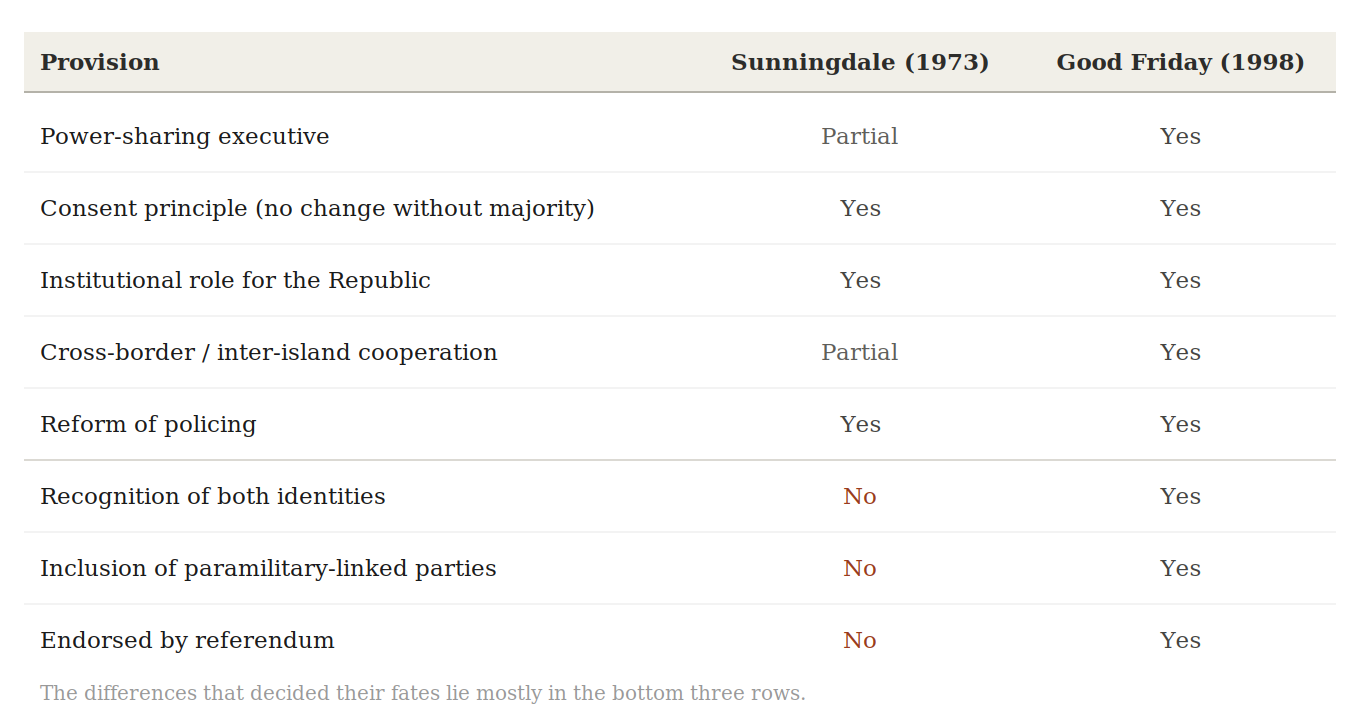
The two settlements are worth laying side by side before tracing how they unfolded. The striking thing is how much they share. Nearly every major provision that appears in the Good Friday Agreement is already present, in some form, at Sunningdale. The design was not the problem.
Sunningdale and its collapse
The Sunningdale executive took office on 1 January 1974 and met opposition the moment it formed. The Council of Ireland, the agreement's Irish dimension, alarmed unionists, who read it as a first step toward a united Ireland, and the Republic's standing constitutional claim over the North gave that fear something solid to grip. But the fatal flaw wasn't constitutional. It was that the people most willing to use force against the agreement had been left entirely outside it.
The collapse came through the Ulster Workers' Council strike of May 1974. The "council" barely existed when the strike began. Its committee had never even met. What gave the strike its teeth was the loyalist paramilitaries who enforced it: roadblocks, intimidation, the methodical shutdown of power, transport, and supply. Inside two weeks the province had stopped functioning. Prime Minister Harold Wilson went on air and called the strikers spongers on British democracy; it backfired, and hardened Protestant resolve. The army was never sent in to break it. On 28 May the unionist chief minister resigned, and the executive fell with him.
The lesson was immediate, and contemporaries read it correctly. The loyalists, in one historian's phrase, had learned they could wreck any arrangement London made that didn't suit them. Two things had combined. One was a unionist community with both the capacity and the will to make Northern Ireland ungovernable. The other was a set of armed men with no stake in the settlement and every reason to smash it. Both would have to change before any settlement could last.
The Anglo-Irish Agreement: the hinge
The first of those two things changed in 1985, and not from inside Northern Ireland. Margaret Thatcher and the Irish Taoiseach, Garret FitzGerald, signed the Anglo-Irish Agreement at Hillsborough, giving the Republic a formal consultative role in the North's affairs through a standing intergovernmental conference. Unionists weren't consulted. London kept them out of the negotiations on purpose.
The reaction was enormous and it did not let up: a 200,000-strong rally in Belfast, Paisley's "Never, Never, Never," a petition with hundreds of thousands of names, mass resignations, open talk of civil war. None of it worked. That is the decisive fact. The Agreement survived the protest precisely because it didn't need unionist consent to exist. It was a treaty between two sovereign governments, built from the outset to be immune to the veto that had killed Sunningdale. One unionist admitted later that short of revolution they had no way to challenge it, and they weren't willing to go that far.
What broke in 1985 wasn't unionist identity, or their votes, or even their influence. What broke was the assumption underneath the whole order: that London would, in the end, side with them. With that gone, unionists were looking at a future where their constitutional fate could be decided without them in the room. That was the shift that made a durable settlement possible. The veto that had been decisive in 1974 simply wasn't available anymore in the same form.
Good Friday and the logic of inclusion
The second thing changed across the following decade, through a process that was slow, deniable, and politically dangerous: bringing the armed actors inside. Old back-channels between the British government and the republicans were quietly reopened. The 1993 Downing Street Declaration laid out the terms on which Sinn Féin could come to the table if the IRA called a ceasefire. The ceasefire came in 1994, the loyalists followed, and after one breakdown and a fresh start the process opened into the multi-party talks that produced the Good Friday Agreement on 10 April 1998.
Inclusion was the whole point. The thesis leaned on the people who actually ran the process, among them Tony Blair's chief of staff, Jonathan Powell, who described the IRA leadership as the invisible presence at the table, the ones Sinn Féin's negotiators had to carry with them at every turn. The same logic applied to the loyalist paramilitaries, with more friction: they had none of the republican movement's political polish, but they were exactly the people capable of running 1974 again. Prisoner releases, ceasefire management, seats at the table for parties tied to armed groups: all of it did one job. It gave the spoilers of 1974 a stake in the settlement of 1998.
Held up against the alternatives, the sequence argument survives. People sometimes say the Troubles ended because of military stalemate, or sheer exhaustion, or the skill of the negotiators, or George Mitchell's American mediation. All of that mattered. But none of it explains the contrast with Sunningdale by itself, because several of those things were present in 1974 too, and the settlement collapsed anyway. Stalemate and exhaustion made a deal attractive. The Anglo-Irish Agreement made it structurally possible, by stripping out the unilateral veto. Including the armed actors made it workable. Police and security reform made it legitimate. The pieces work as a sequence, not as rival single explanations. That is the thesis in a sentence: in Northern Ireland, timing and order did what design alone never could.
5. Does it hold? A 2026 view
The argument is from 2009, when the Good Friday institutions were still young and the St Andrews deal between the DUP and Sinn Féin was only a couple of years old. Almost two decades on, there's enough record to run a harder test. The fairest verdict: the thesis holds, but only once you pull apart two things the 2009 version had folded together.
The agreement was trying to do two different things: end the armed conflict, and produce a stable power-sharing government. At the first it succeeded, and has gone on succeeding. At the second it has succeeded only in fits and starts. The peace is durable. The government is conditional.
The evidence on the first count is strong. Northern Ireland is not at war, and the security situation looks nothing like the Troubles. In March 2024 the intelligence services dropped the region's terrorism threat level from "severe" to "substantial," the lowest it had been in over a decade, following a year in which police recorded no security-related deaths at all, the first time that had happened since the records start in 1969. Dissident republicans are still around, and the threat level has ticked up and down since. But the agreement's central achievement, the end of organized armed conflict, has held.
The second count is where it gets darker, and where it actually tests the original argument. Devolved government has collapsed twice, each time for years. From 2017 to 2020 there was no executive at all: Sinn Féin's Martin McGuinness resigned over a subsidy scandal run out of a unionist department, and the parties then spent three years failing to agree terms for going back in, until the New Decade, New Approach deal finally restored the institutions in January 2020. Then in February 2022 the DUP walked out, this time over the post-Brexit trading arrangements, and refused to return even after the May 2022 election, leaving the institutions empty for another two years until the Safeguarding the Union deal in early 2024.
Brexit is the thing the 2009 thesis couldn't have seen coming, and it's the sharpest test of the whole argument. The tempting move is to read it as a refutation. The better reading is that it's the thesis's own logic playing out again. The Northern Ireland Protocol, and the Windsor Framework that later amended it, left the region in a different trading position from the rest of the UK, with checks in the Irish Sea. Unionists felt about this much as they'd felt about the Anglo-Irish Agreement in 1985: a major constitutional change handed down over their heads, this time by London, Dublin, and Brussels together. The echo is almost exact. What differs is the response open to them. In 1974, faced with a settlement they read as betrayal, the unionist answer was to go outside the institutions: a strike that brought the country down from the street. In 2022 the answer was inside them: refuse to nominate ministers, and bring the government down using the settlement's own rules.
That difference is the single most important thing the years since 2009 have turned up, and it deepens the argument rather than breaking it. The communal veto didn't disappear. It changed address. The Anglo-Irish Agreement took away the unionists' ability to wreck a settlement by mobilizing outside the institutions. What it couldn't take away was the mutual veto built into the Good Friday institutions themselves, where either of the two major blocs can freeze the government just by refusing to take part. The settlement turned the conflict into a constitutional dispute fought inside the rules, exactly as the thesis claimed. It didn't abolish the veto. It domesticated it. And a domesticated veto still stops the government.
Two more developments bear out the long-run trajectory the thesis described. The first is electoral, and symbolic. In 2022 Sinn Féin became the largest party in the Assembly for the first time ever; in 2024 Michelle O'Neill became First Minister, the first Irish republican to hold the office. Set against the order laid out in section 3, that was almost unthinkable. The old unionist monopoly on the region's political destiny has weakened institutionally, through the Anglo-Irish Agreement, and now electorally too. The second development is demographic. The 2021 census found, for the first time since a state was built to guarantee the reverse, more people of Catholic background (around 42 percent, or 46 percent counting upbringing) than Protestant (around 37 percent, or 44 percent), with a large and growing share reporting no religion at all. You can't read politics straight off the census, and it would be a mistake to try. But unionist demographic confidence was one of the props under the old structure, and it has weakened with everything else.
One part of the 2009 thesis needs refining, and it's about paramilitarism. Inclusion helped end the war; that much the thesis got right. What it didn't do was dissolve the armed organizations. It transformed them. The danger in 2026 isn't that the IRA or the loyalist groups drag the province back to civil war. It's that the paramilitary structures live on as residual networks, running coercive control, intimidation, and organized crime in some communities. Inclusion bought an end to the conflict. It did not, on its own, dismantle coercive power at the community level, and that's a distinction the original argument should have drawn more sharply.
So the thesis comes through its own retrospective, with its claims adjusted, not abandoned. The weakening of the unilateral unionist veto and the bringing-in of the armed actors are what explain why Good Friday held and Sunningdale didn't. What the years since reveal is the limit of what that bought: an agreement much better at ending a war than at running a government, carrying within it the very veto logic it was built to contain, except that now the veto works through the institutions instead of against them. That is no small thing. Ending the violence was the harder job and the more important one, and it's the job the agreement did. The recurring collapses aren't accidents, and they aren't just a run of bad personalities. They are the settlement's founding compromise, still doing precisely what it was designed to do, for better and for worse.
The peace is durable. The government is conditional. Both halves of that sentence are the agreement working as designed.
Sources and further reading: the historical argument draws on Jonathan Bardon's A History of Ulster, Brendan O'Leary and John McGarry's The Politics of Antagonism, Jonathan Powell's Great Hatred, Little Room, and the contemporary accounts of participants including Garret FitzGerald, Merlyn Rees, and Mo Mowlam, alongside the primary documents of both agreements. The 2026 assessment draws on the House of Commons Library briefings on the 2022 election and Safeguarding the Union, the Northern Ireland Statistics and Research Agency's 2021 census results, the Independent Reporting Commission's reporting on paramilitarism, and contemporary reporting on the 2017–2020 and 2022–2024 collapses and restorations. Full citations are available on request.
Note on method. The argument, the research, and the sourcing here are mine. I used a large language model for editorial work: organizing the structure and revising at the sentence level. It did not select sources, generate claims, or decide what the essay argues. Every factual statement was checked against the primary sources cited.